A First Look at What’s Coming
We wanted to preview with you a project we’re working on.
The housing story is usually told as a two-hander: landlord vs. tenant. Rents, evictions, homelessness, “bad actors,” “greedy owners.” Clean. Moral. Comfortable.
But if you actually live in this business, you know there’s a third character that never gets a speaking role: the people in the leasing office.
On paper, they tour units and answer emails.
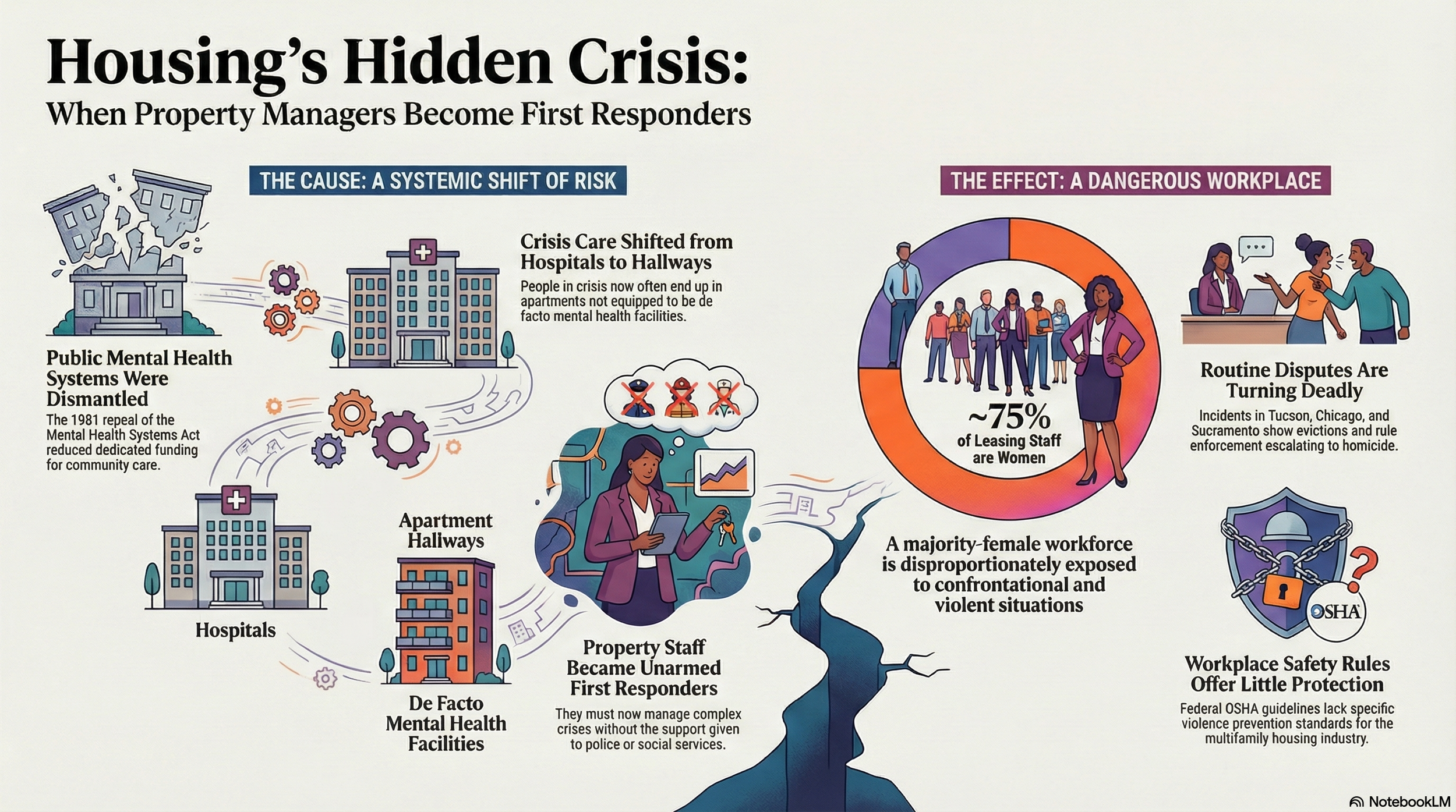
In practice, they sit where three systems now collide:
The long unwind of institutional mental health care that never really got replaced.
Housing stress and street disorder moving into ordinary market-rate and workforce buildings.
Policy stacks — tenant protections, nuisance rules, narrowed screening, slow courts — written for a different era of risk.
The result is boring on paper and sharp in real life:
Leasing staff doing frontline work with almost none of the safety framework we expect in hospitals, shelters, or social-service agencies — but with similar volatility walking through the door.
The work we’re doing in Dangers in Property Management traces that shift through real properties, real cases, and the quiet ways it shows up in rent rolls, delinquency, staff turnover, and how long “routine” enforcement can drag on before anything actually happens.
A preview:
“The housing debate is staged as owner vs. tenant. The violence, fear, and friction in between land on the people with a key ring and a name tag. They are not policy makers or capital allocators. They’re the only ones in the room.”
“Over forty years, we shut down psych beds, promised ‘community care,’ and then quietly outsourced the day-to-day reality to whoever was standing in the hallway of the nearest apartment building. We still call it ‘property management,’ as if this is about late fees and pet addenda.”
“OSHA can tell you how a hospital should handle a violent patient, how a shelter should design for risk, how a social worker should be trained for crisis. Ask the same question about a leasing office, and you get a shrug. The law assumes these are clerical workers. The job description says otherwise.”
The project isn’t trying to make anyone a hero or a villain. It follows a simple question — what exactly are we asking property staff to carry now? — all the way to its operating and financial consequences.
Full piece and supporting formats coming soon from Starboard, please let us know how we can help you and your clients in the meantime!